Places We Visit
Iona
Iona is a small island in the Inner Hebrides off the western coast of Scotland, it is a low-lying island only 3 miles long by a mere 1.5 miles wide, with low craggy hills overlooking pale sandy beaches and crooked coves.
The prestige of Iona began in AD 563 when the Celtic bishop Columba and his twelve companions sailed from Ireland to found a monastery here and used it as a base from which to convert the Picts to Christianity. The monastery was attacked and burned six times by Vikings and was eventually abandoned in favour of Kells in Ireland.
lona was occupied again in 1203 as a Benedictine monastery, but it fell into ruin during the Reformation when symbols of the Roman Catholic faith came under attack.
The oldest surviving building is St Oran’s chapel (c. 1080), and the ornately carved St Martin’s Cross (10th century) stands outside the cathedral.
Today lona is a sacred place visited by well over 200,000 pilgrims every year.
Lastingham
Lastingham is a village and civil parish which lies in the Ryedale district of North Yorkshire, England. It is on the southern fringe of the North York Moors, five miles north east of Kirkbymoorside, one and a half miles to the east of Hutton-le-Hole. It was home to the early missionaries to the Angles, St. Cedd and his brother, St. Chad.
Whitby Abbey
Whitby Abbey is a ruined Benedictine abbey overlooking the North Sea on the East Cliff above Whitby in North Yorkshire, England. It was disestablished during the Dissolution of the Monasteries under the auspices of Henry VIII. It is a Grade I Listed building in the care of English Heritage.
Durham Cathedral
Durham Cathedral is a cathedral in the city of Durham, England, the seat of the Anglican Bishop of Durham. The Bishopric dates from 995, with the present cathedral being founded in AD 1093. The cathedral is regarded as one of the finest examples of Norman architecture.
The present cathedral replaces the 10th century "White Church" built as part of a monastic foundation to house the shrine of Saint Cuthbert of Lindisfarne. The treasures of Durham Cathedral include relics of St Cuthbert, the head of St Oswald of Northumbria and the remains of the Venerable Bede. In addition, its library contains one of the most complete set of early printed books in England, the pre-dissolution monastic accounts, and three copies of the Magna Carta.
The Holy Island of Lindisfarne
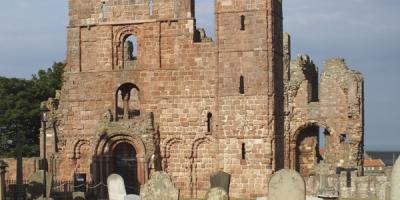
The Holy Island of Lindisfarne In 635AD St. Aidan came from Iona and chose to found his monastery on Lindisfarne. The Christian message flourished here and spread throughout the world.